
Dutch Flower Painting
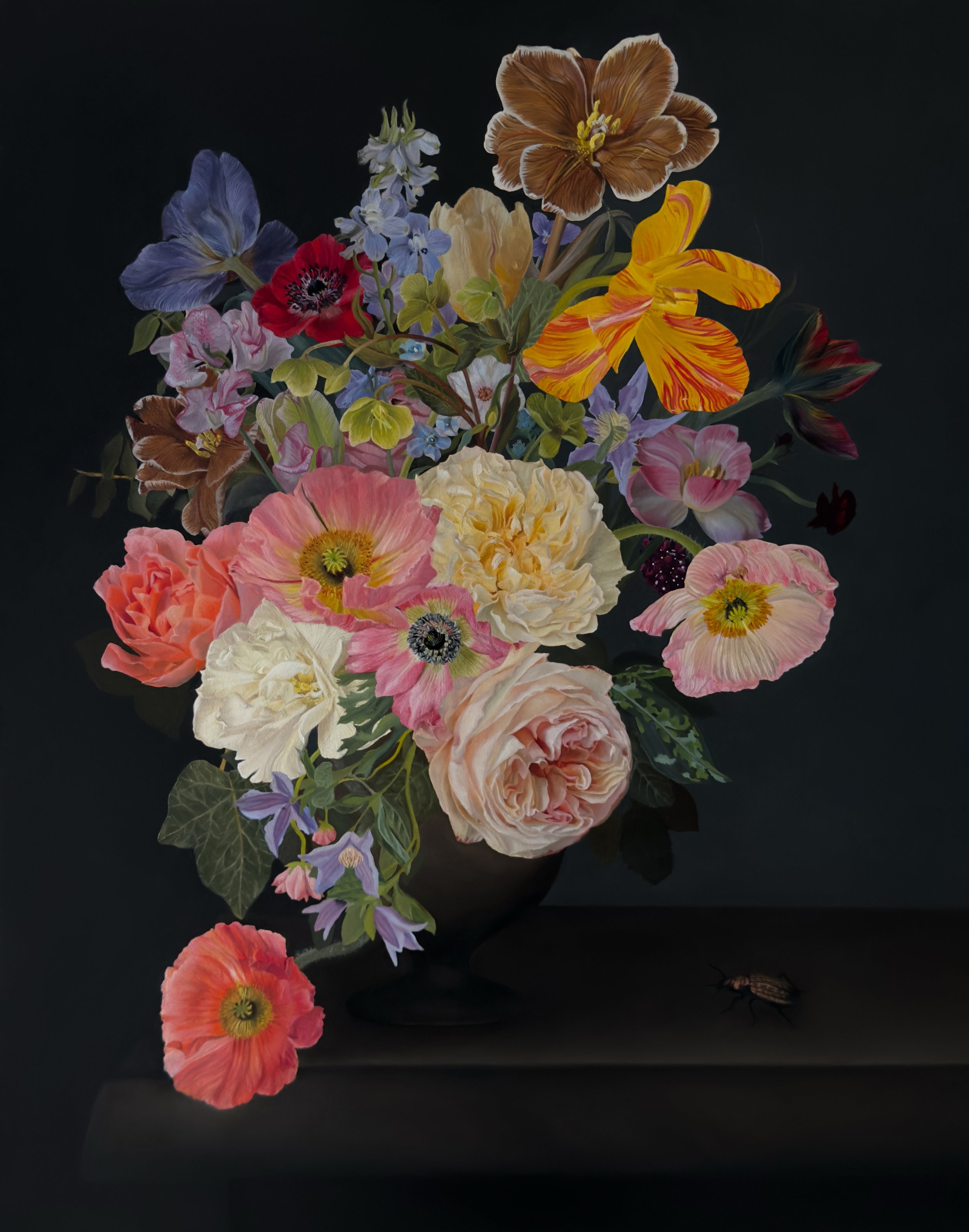
The Signature of all flowers: Oil on panel 40 × 50 cm (16 × 20 in)
The same technique, painted 400 years later.
The History:
By the early seventeenth century, Holland had become the wealthiest society in Europe, a republic of merchants, with crowded ports and the world’s first stock exchange. Art was no longer made for churches and kings, but for people’s homes. And in those homes, the supreme object of desire was the flower: rare tulips, imported from the East, sold for the price of a house. A painted bouquet offered what no bulb could promise, it never wilted. The genre evolved across the lifetimes of several generations of artists who learned from one another, many were, quite literally, each other’s teachers and pupils, each refining what they had inherited, up to a peak that art history has never matched since. Over the centuries, painters have kept returning to this technique, and today a very small number of specialized artists practice it again at a high level, yet almost no one has equaled the mastery of the painters of 1700.
Ambrosius Bosschaert (1573–1621) founded the genre: symmetrical, almost solemn bouquets, each flower placed with a jeweler’s care. Jan Davidsz de Heem (1606–1684) broke the stiffness, his compositions brought movement and life. Willem van Aelst (1627–1683), a court painter in Florence before returning to Amsterdam, introduced the asymmetrical, spiraling arrangement that seems caught by chance. Into his studio came, at fifteen, Rachel Ruysch (1664–1750), daughter of a famous professor of botany, trained by Van Aelst for four years until his death. She became the most celebrated flower painter of her age, her works commanding higher prices than Rembrandt’s; she painted until she was 83, and in 2024–2025 the Alte Pinakothek in Munich, the Toledo Museum of Art, and the Museum of Fine Arts, Boston dedicated to her the first major retrospective in history. Last in the line, Jan van Huysum (1682–1749) opened the backgrounds toward light and carried technical refinement to a point no one has reached since.
The Technique:
One thing to understand from the start: this is not realist painting, but naturalist painting. The aim is not to copy a flower, but to render its sensation, its weight, and the way light passes through it. It looks more magical than reality, precisely because nothing you see ever existed this way. The essential truth of this genre: the bouquet never existed. The flowers gathered on one canvas bloom in different seasons. The light that unites them is invented. The arrangement is a fiction impossible to place in any real vase. The painting is built flower by flower, each specimen painted separately, composed like an assembled collage that must read as a single moment.
The Dutch had a word for what holds it all together: “houding”, the tonal and spatial organization of the picture as a whole. Mastery here does not rest on one thing, but on everything at once: the level of the drawing, the color, the composition, how you bring it all together, how you build the axes of movement through the work, the level of detail that sets you apart. Many flowers, many movements and all of them must breathe together. The modeling of each flower, the way form turns through light, is the heart of the technique. Just as much depends on which pigments you use and how you handle them, and the depth of color comes from glazing: transparent layers of pigment applied over dried paint, letting light pass through and return, a jewel-like luminosity impossible to achieve by direct mixing on the palette.
About My Journey:
I was drawn to flowers before I painted in oil, for years I rendered them in pencil, ink, pastel and digital. When I discovered oil painting at the Florence Academy of Art, I knew I had found the medium that could carry what I was searching for. And for the floral genre, I went directly to the source: a six-month mentorship with Carlo Russo, the program “The Complete Dutch Floral” one of the few artists in the world specialized in Dutch flower painting. I then followed it with three further months of in-depth study of individual flowers, in his dedicated course “Just Flowers”.
Within the mentorship I completed my first full composition in this technique, “The Signature of All Flowers” 40 × 50 cm (16 × 20 in). The collection will continue to grow over time with diverse works. I am now developing the tradition in my own stylistic direction keeping the genre’s precision of drawing and its construction, while opening it toward my own sensibility: an aesthetic of calm and pastel tones. Of all the masters, Rachel Ruysch is closest to me for the balance she found between rigorous construction and apparent effortlessness.
Currently in progress:
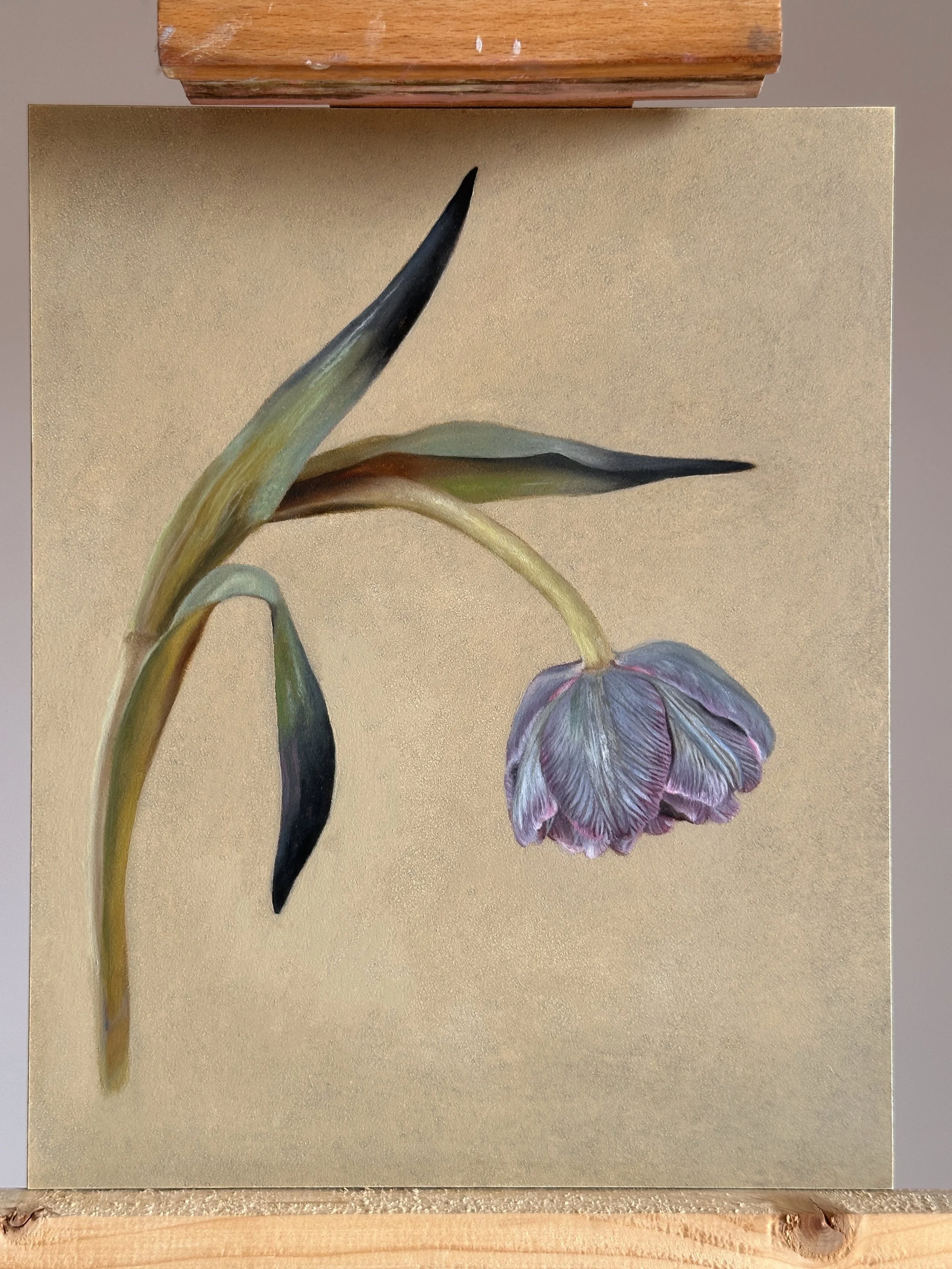
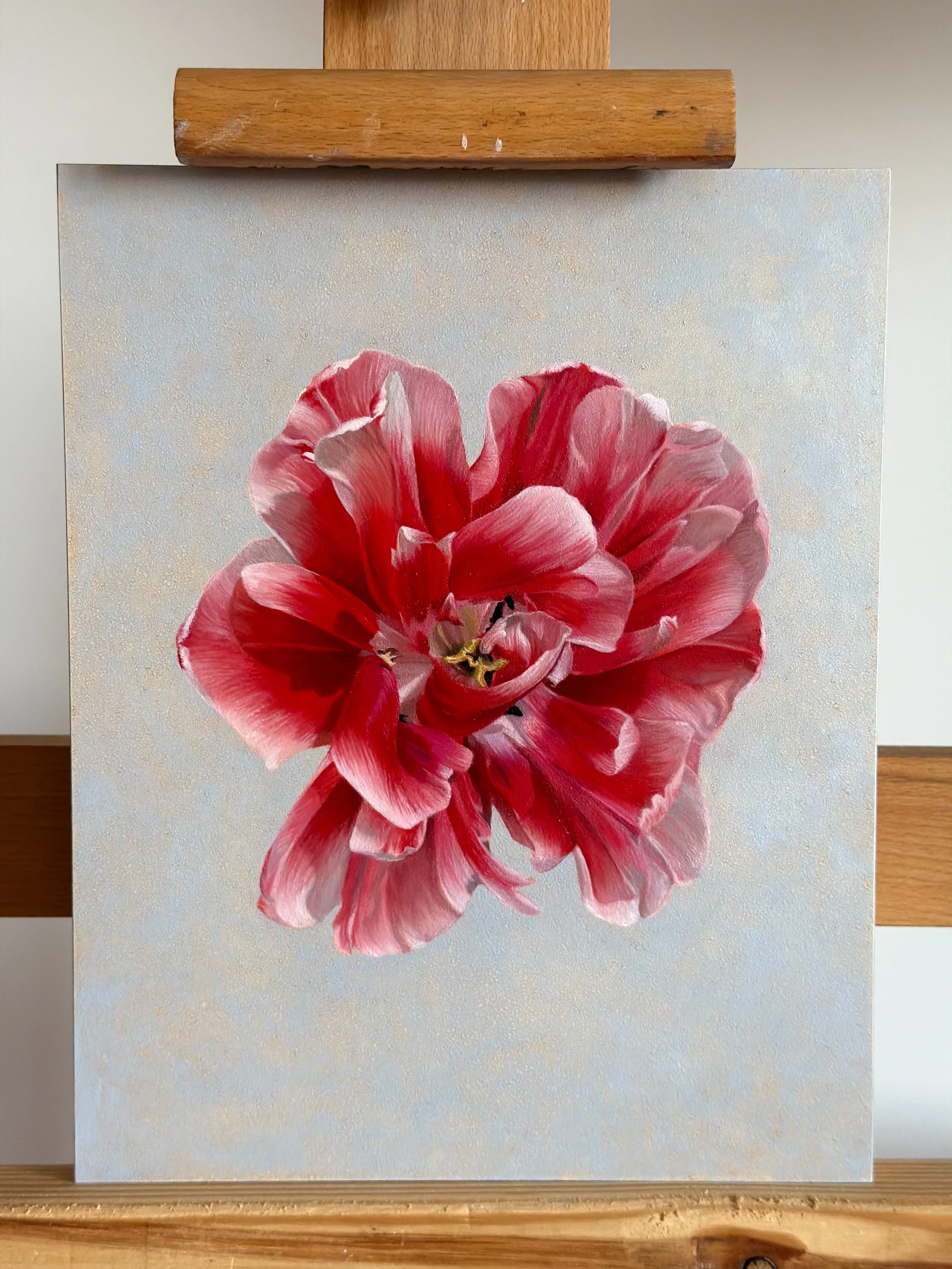
Individual studies 20 × 25 cm (8 × 10 in).
A single bloom on each piece: autonomous works that also serve as preparatory studies for future bouquets, in the manner of the old masters, and in my own style.
Works may be acquired directly from the existing series; commissions on brief are also possible.
When a composition is selected for international exhibitions or awards, it temporarily returns to my custody, with the collector’s consent, and afterward rejoins the collection, its exhibition history added to its provenance.
Separately from the floral series, I also work in classical still life, in the tradition studied at the Florence Academy of Art, a school built on the sight-size method, the discipline of visual accuracy. These works, quiet arrangements of objects painted from direct observation are also available on commission.